We have seen that names have significant meanings, and as discussed earlier, Elimelech, whose name means "My God is King", left Bethlehem with Naomi his wife and their two sons. The birth of these two boys must have brought joy and happiness, yet, having perished in Moab actually caused their very names to lose their original meanings.
by George Whitten, Editor of Worthy Devotions Jeremiah 31:31-33 Behold, the days come, saith the LORD, that I will make a new covenant with the house of Israel, and with the house of Judah: Not according to the covenant that I made with their fathers in the day that I took them by the hand [...]
Hebrews 10:19-22 Having therefore, brethren, boldness to enter into the holiest by the blood of Jesus, By a new and living way, which he hath consecrated for us, through the veil, that is to say, his flesh; And having an high priest over the house of God; Let us draw near with a true heart [...]
Today marks Holocaust Memorial day here in Israel. At ten o'clock in the morning on this day, war sirens sound calling the entire Land to remembrance of the 6,000,000 Jews who died and many more who suffered under the Nazi regime during WW2. People in their homes and workplaces rise in silence; cars come to a halt, even on the highways; pedestrians stop where they are and pause… for one minute as the sirens wail, we remember.
Ruth 1:16-17 And Ruth said, Intreat me not to leave thee, or to return from following after thee: for whither thou goest, I will go; and where thou lodgest, I will lodge: thy people shall be my people, and thy God my God: Where thou diest, will I die, and there will I be buried: [...]
One of my favorite "hidden" lessons in the Pesach (Passover) celebration "Seder" meal is the mystery of the “afikomen.” This specially prepared meal– during which the participants are reminded of Israel's supernatural deliverance from Egyptian slavery by the mighty hand of God– also includes 3 particular pieces of matzah, (unleavened bread). These three are placed in a "matzah tash" — a special pouch containing three compartments…
The Book of Daniel prophesied in this passage, that the Messiah will come and be cut off, and then the city of Jerusalem and the sanctuary (the temple) will be destroyed. The city of Jerusalem was destroyed by the Roman army led by Titus in 70 AD.
Recently the rain has been coming down throughout Israel, in such abundance that the Sea of Galilee is at the highest point since 1994.
The parable of the Prodigal son might also serve as an illustration of the relationship between Israel and the Church.
A National Geographic article published a few years describing a real celestial event which took place at the time of the birth of Jesus reminded me of Risto Santala’s explanation in his book, "The Messiah in the New Testament in the Light of Rabbinical Writings". He wrote about a conjunction of major planets that took place which could have led the wise men from the east, to Israel.
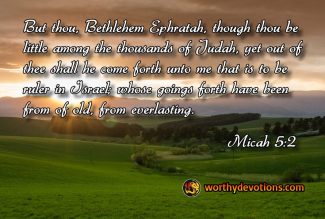
There are many who are not aware of the very deep significance of Bethlehem,Yeshua's (Jesus') birthplace. Everyone knows that Bethlehem was a place where shepherds grazed their sheep, and where the Messiah was to be born, but do not realize that it was a town designated as the birthing place for lambs which were used for the Passover sacrifice. The Scriptures give significant details about this little town lying slightly south of Jerusalem.
As parents trying to raise kids in this world, we're constantly reminded by the Lord of Proverbs 22:6, 'Train up a child in the way he should go: and when he is old, he will not depart from it.' The Hebrew word 'train', in this passage is, 'Chanak' which can be translated, 'train up' or 'dedicate.' It's the root word from which we get the word, Chanukah.
As the war continues in Israel, much has been made of the success of the Iron Dome defense system which shoots down incoming rockets from the Gaza Strip. While we are very thankful for the protection this system affords, it does present a certain public relations challenge for Israel. Somehow, regardless of the differences in both size and intention between Israel and the Arab world, the global media frequently emphasizes what they call, “moral equivalency”. The perception of Israel's military strength and technical superiority somehow makes her the aggressor with an unfair advantage.
Throughout the history of the modern state of Israel, there have been accounts of angelic interventions protecting Israeli soldiers in the midst of intense warfare. One instance recounted by an Israeli military historian after the 1973 Yom Kippur war, describes an Israeli soldier in the Sinai taking captive an entire Egyptian column and leading them to where the Israeli troops were. The Egyptian commander was asked why he and his men gave themselves up to the lone Israeli soldier. He responded with surprise, "One soldier? There were thousands of them."
As most of you know, this past week the conflict in Israel has escalated. The IDF has termed Israel’s military operation, “amood anan”, which in literal Hebrew, means, “pillar of cloud”. In English it has been rendered, “pillar of defense”. The term is a direct reference from the Exodus of Israel from Egypt when they were led out of slavery and protected by a pillar of cloud by day and a pillar of fire by night.[Exodus 13:21]. The pillar both led (directed and guided) and protected the children of Israel from the Egyptian army…providing both leadership and protection.
The Day of Atonement, Yom Kippur in Hebrew, was the single most important day during the time of Yeshua (Jesus) and still holds utmost significance in Israel and among Jews worldwide today.
Yom Kippur, the Day of Atonement is upon us. Beginning tomorrow evening, Yom Kippur marks the holiest of all holy days on the Hebrew calendar. It is the anniversary of the fall of man and it is the climax of the time of Teshuvah (repentance). Starting tomorrow night and into Saturday, all around the world, the religious will fast from food and water and read prayers in the synagogue, as will the majority of traditional Jews.
One of the more beautiful ceremonies of the Jewish faith is called "Tashlich". Tashlich means to cast away. Every year between Rosh haShana and Yom Kippur, Jewish people around the world journey to a nearby river or stream and cast in bread crumbs as they confess their sins. As the bread crumbs are swept downstream soon to be out of sight, so they believe God will sweep away their sins.
This Sunday night begins the feast of Rosh Ha Shannah, or Yom Teruah — the Feast of Trumpets. At the end of the summer the Hebrews are commanded to blow the shofar — the ram’s horn, all day long. The sound of the shofar was a sound of alarm — it told the people to get ready. It marked in the calendar that the summer harvest was over and the day of atonement was near and it was time to stand before God.
The book of Isaiah, often called the Old Testament Gospel, reveals that a child was to be born and his name called “The Mighty God, and the Everlasting Father”. We know that this Child was Yeshua (Jesus) of Nazareth, that He is the unique Son of God, the express image of the invisible God. The throne of David was to be given to Him and He now holds its "key", a symbol of the right and authority of His reign, which will be consummated when He returns to this world and restores the Kingdom to Israel [Acts 1:6-7].