The story of the Exodus is a story of miracles – yet in the beginning when Moses first appeared before Pharaoh to deliver the children of Israel from 400 years of slavery, the Israelites were severely tempted and became angry because of the initial hardships that were laid upon them.
As we continue our study in Ruth during this Shavout season, the theme of redemption is prevalent. We read that Boaz became Naomi and Ruth's "kinsman redeemer", or "goel" – from the Hebrew, "lig'ol", to redeem, receive or buy back. In the Torah, a provision had been made for the poor person who was forced to sell part of his property or even himself (into slavery). This man's nearest of kin could step in and "buy back" or "redeem" what his relative had been forced to sell. [Leviticus 25:25] A slave could be redeemed from his bondage by his "goel" who literally purchased his relative's freedom.
As Scotland was declaring its independence from England in the 1300's, the English were hunting for Robert Bruce of Scotland in an attempt to prevent his accession to the Scottish throne. In the search, the English put Bruce's own bloodhounds on his trail. As they grew closer to apprehending him, Robert the Bruce found a small river, and he said to his foster-brother who was with him, "Let us wade down this stream for a great way, instead of going straight across, and so these unhappy hounds will lose the scent; for if we were once clear of them, I should not be afraid of getting away from the pursuers."
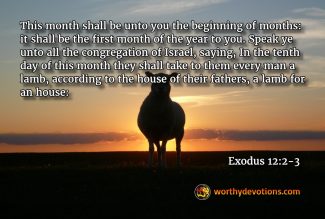
Tomorrow begins the holiday of Pesach (Passover), the day we remember God's merciful redemption of the Jewish people from Egypt. When the final plague struck Pharoh and the Egyptians in Exodus, those who were spared were were the ones who applied blood to their doorposts as God warned. Interestingly, the blood that God required them to apply then was the blood of a spotless, unblemished lamb.
An ancient Hebrew commentator wrote of this verse, "In the words of our teachers of blessed memory and in the Midrash [ancient Hebrew commentaries of the O.T.], it is taught that the 'breaker' is Elijah and 'their King' is the branch of the son of David."
Another interesting correlation we draw from Mashiach Ben Joseph is how Joseph was the object of his father’s (Jacob) love, just as Yeshua (Jesus) was loved of our Heavenly Father. This preference Jacob had for Joseph was unequivocal, and it was also pretty controversial among his brothers…
Yesterday, I began to touch on the significance of "rachamim", the mercies of God. The scripture expressed that our sins are removed as far as "the east is from the west" — meaning they are completely forgiven when confessed. On the feast of Yom Kippur, or the Day of Atonement two goats are involved in the sacrifice.
One of my favorite heroes of the faith is Hudson Taylor. For those who are unfamiliar with him, Hudson Taylor led a great awakening in China which continues to this day.
Race car driving champion Bill Vukovich won the infamous Indianapolis 500 race two times, a record of success few others have achieved. When asked about the secret of his success in the race, Vukovich simply replied, "There's no secret. You just press the accelerator to the floor and steer left."
Israel is celebrating its Independence today. Just before Israel celebrates its independence, it mourns those whose blood was shed for its freedom and then celebrates its freedom.
Two shopkeepers were bitter rivals. Their stores were directly across the street from each other and they would spend each day keeping track of each other's business. If one of them got a customer, he would smile in triumph at his rival.
This groundbreaking conversation took place at Caesarea Phillipi, which lies today in the modern day reserve of the Banias in the Golan Heights region of Israel. The city was established by Ptolemaic Greeks, a Hellenistic community where the worship of the god Pan was centered. Reviled by the Jews of Yeshua's time and considered by them the most idolatrous place in the entire Galilee, to this day it remains a place of nature worship and deep paganism…
I love this story! Peter was sitting between two guards and suddenly an angel of the Lord comes to him and frees him — and he thinks it's a vision! He's not sure if he truly believes it.
As we discussed last week, the word for "sign" in ancient Hebrew is "oht". It was used in Genesis to designate God’s covenant sign with Noah, (the rainbow). And we see now the same word again, in Exodus, identified with the deliverance of the Jewish people from the tenth plague, when the angel of death passed through all Egypt to strike the firstborn. Anyone under the "sign" of the blood was spared.
We continue looking at the ancient Hebrew alphabet: the modern word for "religion" is the word – "dat" – spelled in Hebrew, "dalet"- "tav". The ancient Hebrew letter "dalet" pictures a door. And as we have previously shown, the "tav" is a covenant sign which is pictured as a simple cross. So the word "religion" in ancient Hebrew, could also be expressed as "the door of the covenant sign (a cross)”.
Once upon a time, there was a prince who received a very rare and beautiful bird. He named her Goldie and placed her in a lovely, 14K gold cage. But the poor creature was not impressed by the gold at all. She pleaded for her freedom but the prince loved her much too much to part with her. Still, she continued to beg. In final desperation, she asked that he at least allow her go to her relatives and tell them that, though captive, she was still alive.
Philippians 3:13-14 Brethren, I count not myself to have apprehended: but this one thing I do, forgetting those things which are behind, and reaching forth unto those things which are before, I press toward the mark for the prize of the high calling of God in Christ Jesus. We came across this story, about a [...]
The enemy has only come to lie to us, kill and destroy us. The rejection we receive is ultimately from him — the person who outwardly does the rejecting is merely a pawn in his game. That rejection is a lie! Over time we begin to believe that lie until it finally becomes truth in our hearts. We can live a lifetime believing that lie. We can spend years and years covering for it as we talked about yesterday, with pride, fear and rebellion. And these build walls — walls that imprison us — and isolate us from the ones we love.
Charles Swindoll wrote about these men who bring in animals from Africa for American zoos. They say that one of the hardest animals to catch there is the ringtailed monkey. For the Zulus of that continent, however, it's simple. They've been catching this agile little animal with ease for years.
Ever use that phrase on your kids? "Come on, will you grow up already?!"