The Hebrew expression in this verse from Isaiah is rich with meaning. The root "nus" (from the expression "raise up a standard") is related to or sounds like numerous words which mean "sign", "miracle", "to drive away", "to flee", "cause to disappear", "a waving flag". This abundance of meanings in Isaiah's poetic style reveals the multiple dimensions of God's revelation; in this case, the way he deals with evil. The assertion in this word is that the Spirit of YHVH will be powerfully activated when evil comes.
by George Whitten, Editor of Worthy Devotions Jeremiah 31:31-33 Behold, the days come, saith the LORD, that I will make a new covenant with the house of Israel, and with the house of Judah: Not according to the covenant that I made with their fathers in the day that I took them by the hand [...]
Let's consider Daniel for a moment. Here is one of the great rulers of the Persian empire, in charge of the King's affairs and of the affairs of the entire government. Now if anyone is really busy — it's Daniel! But in spite of all this, he makes it a point to set himself apart from the world and pray three times a day.
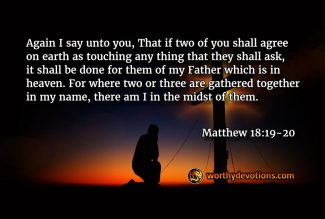
Matthew 18:19-20 Again I say unto you, That if two of you shall agree on earth as touching any thing that they shall ask, it shall be done for them of my Father which is in heaven. For where two or three are gathered together in my name, there am I in the midst of [...]
Once there was a king who decided to set aside a special day to honor his greatest subject. When the big day arrived, a large gathering took place in the palace courtyard and our finalists were brought forward.
In ancient times, lepers were social outcasts because of their highly contagious disease. In this passage, ten lepers came to Jesus begging for mercy and He graciously healed them.
Have you ever heard of the Valley of Elah? It's the valley near Bet Shemesh where David defeated Goliath, yet this historic battlefield is virtually untouched in Israel. During the rainy season a brook runs through the midst of the valley, however it dries up during the summer. This brook is very likely the one from which David chose his five smooth stones – one of which was used to kill Goliath. Yet, this historic place has no landmarks, no churches – people drive past it all the time unaware of it's biblical or historic significance.
In this prophetic passage the critical question is immediately followed by the powerfully convicting answer. Joel prophesies the Day of the Lord, and asks, "Who can endure it?" The next word "therefore", is followed by the prophet's urgent counsel: "Turn to me with all your heart, with fasting, with weeping and with mourning!"
A reader asked a pointed question, "How do we claim the promises of God?" Sometimes the most difficult questions are best answered by men of faith, in this case, by a man who made a lifestyle of claiming the promises of God. I learned the answer to this question early in my walk when I read the autobiography of George Mueller.
Have you ever thought about how much power God releasing in our midst right now? Is it 20%… 50%… 100% of His great power?? I would venture to say that God is not even releasing a fraction of 1% of His power today. That might sound crazy to you, but think about it. If He were to release all His power on this earth, don't you think that sin would be completely destroyed and righteousness and holiness would abound?
Robert A.Cook, president of The King's College in New York, was speaking at the Moody Bible Institute some years ago. He was saying that the day before, he had been at a gathering in Washington and had talked with Vice President George Bush. And went on to say that he later spoke briefly with President Ronald Reagan.
In the eleventh century, King Henry III of Bavaria grew tired of court life and the pressures of being a monarch. He made application to Prior Richard at a local monastery, asking to be accepted as a contemplative and spend the rest of his life in the monastery. "Your Majesty," said Prior Richard, "do you understand that the pledge here is one of obedience? That will be hard because you have been a king." "I understand," said Henry. "The rest of my life I will be obedient to you, as Christ leads you." "Then I will tell you what to do," said Prior Richard. "Go back to your throne and serve faithfully in the place where God has put you." When King Henry died, a statement was written: "The King learned to rule by being obedient."
It was recently during Hurricane Sandy that I read how teenagers for the first time ever had to live without any electricity, and (can you even imagine) – without a cell phone! For the first time in their lives they enjoyed the privilege of experiencing what life was like decades ago. Forced to slow down, unable to text or "Facebook", everyone who lost power entered a "moment" of technological communication silence, and they waited anxiously for the powers that be to restore their normal life patterns.
The apostle Paul's epistle to the Thessalonians contains clear and powerful exhortations concerning the will of God for believers. These exhortations express the specific will of God in relationships with others, with ourselves, and with the Lord. Packed into these short verses are patterns of life and behavior which receive His blessing in all these relationships.
Roughly 3000 years ago during this month, King Solomon dedicated the Temple he had built for the Lord. So it was in the Hebrew month of Tishrei, the month of the fall feasts of Israel, that the presence of the Lord fell and the glory of God was displayed in the Temple.
When I was younger I used to take an ax and cut up firewood from the woods behind our house. The one thing I always did was sharpen my axe! A dull axe meant harder work chopping through fallen trees. The sharper the ax the less effort and energy required for the task. So I learned early on to sharpen my ax before venturing into the woods, and I saved myself a lot of time and energy. (Besides I was a small kid, growing up, so I needed all the help I could get! ;) )
Joseph interpreted dreams and revealed their meaning to those around him, and so Pharaoh gave him the name, Tsofnat Paneach (Zaphnathpaaneah) which means the "Decipherer or Revealer of Secrets". Yeshua, (Jesus) at his first advent as "Mashiach ben Yosef" also came revealing secrets; not as an interpreter of dreams, but as one who disclosed the secrets of men…
Since moving to Israel we've been thrust into a Middle Eastern culture of "extreme hospitality". The above parable from Luke takes place in a similar cultural context, and it powerfully illustrates how God wants us to approach Him.
Throughout the United States today, everyone will be celebrating the anniversary of the signing of the Declaration of Independence — a document through which leaders of the colonies in the New World broke free from the King of England.
A farmer and his friend went duck hunting. Eventually, they got to talking about the things of God, as they always would. "You're always talking about these battles you have with the devil," the farmer's friend said to him. "It's so silly – I mean, I'm not even a Christian and I've never experienced anything like that."