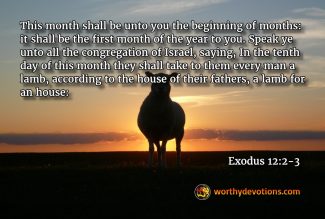
As we discussed last week, the word for "sign" in ancient Hebrew is "oht". It was used in Genesis to designate God’s covenant sign with Noah, (the rainbow). And we see now the same word again, in Exodus, identified with the deliverance of the Jewish people from the tenth plague, when the angel of death passed through all Egypt to strike the firstborn. Anyone under the "sign" of the blood was spared.
This is one of my favorite promises in the Bible — that God turns mourning into dancing! He takes away the anguish of being clothed in sadness and replaces it with gladness. However, notice what God doesn't do — simply stop your mourning and make it disappear. No, He transforms it…into joy!
An interesting parallel exists between these two passages of scripture: Isaiah 53:9 and Acts 3:15. Isaiah renders the "death" of the messiah in the plural form, "deaths" ("mavtei"). Acts renders the life of the Prince of Life as "lives" ("chaim"). Some scholars suggest that the plurality of the word death indicates a violent death this servant would suffer, and that making the noun plural is a way of emphasizing the terrible intensity of his experience. Jewish counter-missionaries suggest that the "death" in plural shows that the suffering servant is not an individual man, but a group of people, specifically the nation of Israel, thus denying that the passage refers to an individual messianic figure. A friend of mine offers a third possibility, that Yeshua's (Jesus) death(s) was compound and complete, in that He died spiritually, being separated from the Father by sin, died in soul, because His heart was broken, and died in body, through torture and crucifixion.
We have seen that names have significant meanings, and as discussed earlier, Elimelech, whose name means "My God is King", left Bethlehem with Naomi his wife and their two sons. The birth of these two boys must have brought joy and happiness, yet, having perished in Moab actually caused their very names to lose their original meanings.
There are two kinds of birds that roam the desert: vultures and hummingbirds. The vulture thrives on a diet of rotting meat. He flies overhead searching for traces of leftover carcasses from slow-footed critters eaten by wild animals who’ve already had their fill.
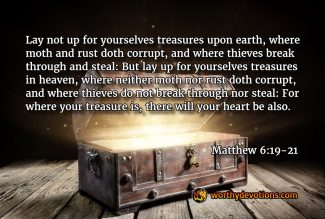
Some time ago, we wrote about pearl harvesting as an illustration of how the Lord takes us into His "shell" like an irritating grain of sand, and over time, covers us with His beautiful covering, forming us into polished and precious gems for his glory and delight. This image of sanctification takes the metaphor in one direction: but here is another interesting thought. The beautiful pearl inside the oyster cannot be seen or enjoyed without a great price being paid. The oyster must die. It must be torn open in order to find the treasure within. This speaks to me of the original foundation and source of our beauty. Yeshua (Jesus) our Messiah had to be bruised, afflicted, torn and killed so that the beautiful treasures God intended us to be from the beginning, could be discovered and released from the darkness of sin.
In the 1883, Captain Sampson of the British navy witnessed one of the greatest volcanic eruptions in history which took place in Indonesia. The eruption was so powerful that its shock waves traveled around the world seven times. The volcano shot miles of debris into the atmosphere which fell to earth as far away as Madagascar – over 2000 miles distance.
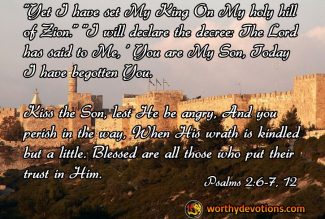
The central fact of the gospel message is the resurrection of Yeshua (Jesus), declared in Psalm 2, the begotten Son of God. In 1952, Dead Sea scrolls were discovered in Cave 4 called the "Messianic Apocalypse". The Messiah's ministry of resurrection is reiterated in these ancient documents with an obvious reference to Isaiah 61:1-3. The scroll identifies someone who "… will heal the wounded, and revive the dead …
Psalms 97:10-12 Ye that love the LORD, hate evil: he preserveth the souls of his saints; he delivereth them out of the hand of the wicked. Light is sown for the righteous, and gladness for the upright in heart. Rejoice in the LORD, ye righteous; and give thanks at the remembrance of his holiness. Driving [...]
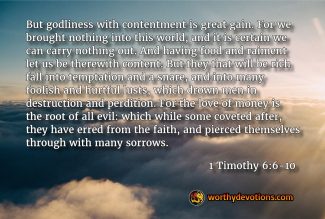
1 Timothy 6:6-10 But godliness with contentment is great gain. For we brought nothing into this world, and it is certain we can carry nothing out. And having food and raiment let us be therewith content. But they that will be rich fall into temptation and a snare, and into many foolish and hurtful lusts, [...]
1 Corinthians 15:55-58 O death, where is thy sting? O grave, where is thy victory? The sting of death is sin; and the strength of sin is the law. But thanks be to God, which giveth us the victory through our Lord Jesus Christ. Therefore, my beloved brethren, be ye steadfast, immoveable, always abounding in [...]